










Publicado el 10 Febrero 2024
Angel Pineda: Prosecutors Spearheading Vital National Responsibilities
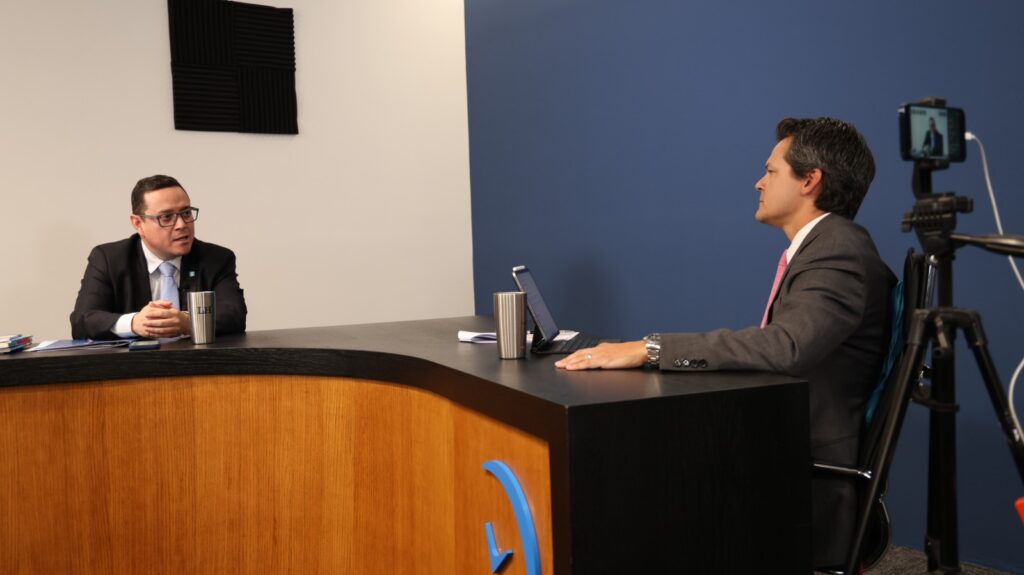
The Secretary-General of the Public Ministry of Guatemala (MP), Mr. Angel Pineda, granted an interview to the media outlet La Hora, where he addressed various topics related to the work of the Public Ministry of Guatemala.
Mr. Pineda emphasized the importance of clarifying various issues and began with La Hora’s recent article regarding the visits of the Attorney General of Guatemala to the Presidential Palace.
It is apparent that she is depicted as not attending the Presidential Palace with the current President of the Republic, yet she did attend in the past with the two presidents who were in office during her tenures as Attorney General.
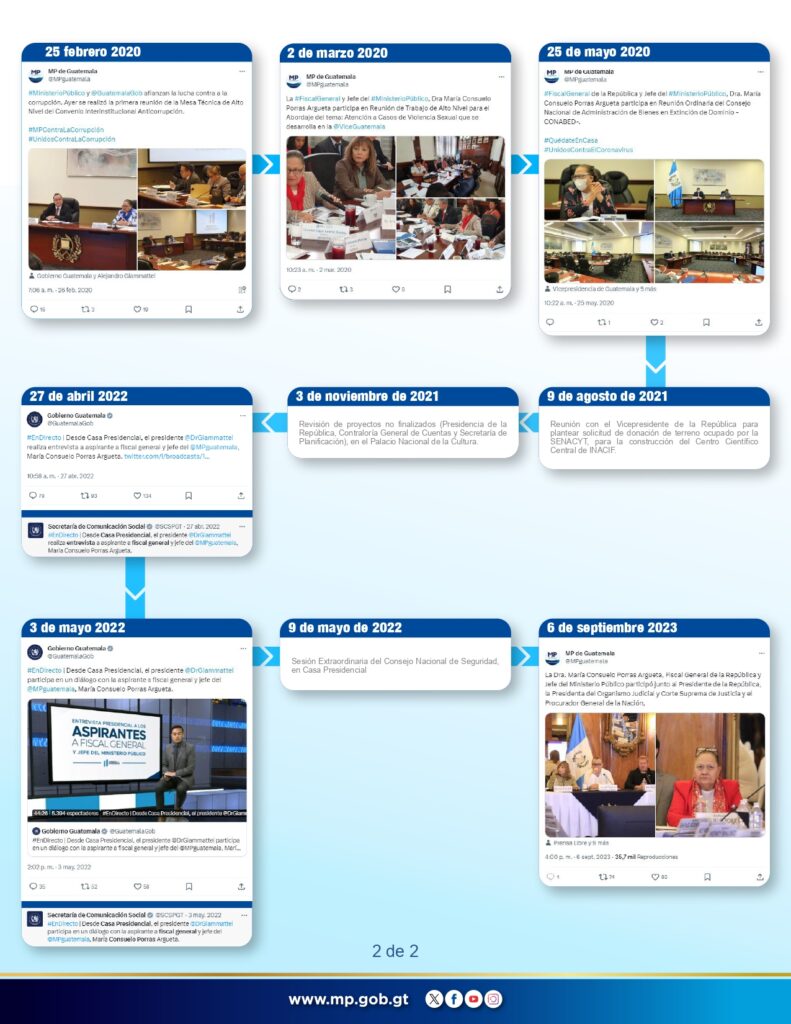
Detail of the meetings that have been maliciously publicized in an attempt to distort the nature of regular inter-institutional coordination meetings and to discredit the objective and impartial work of the Public Ministry of Guatemala.
Contrary to the portrayal of circumstances suggesting a positive relationship regarding the Attorney General’s visits to the Presidential Palace, the reality differs.
In legal terms, we are dealing with public officials or employees, and we are subject to the law, as all citizens are. The republican system of government is based on the separation of powers, where the State delegates power, but the Constitution clearly states that the power exercised by the State will have two limitations: the Constitution and the laws. Therefore, citizens can do everything the law allows, but there are always rules limiting the exercise of rights, which are not absolute.
As public employees, our actions are even more limited, confined to only what the law expressly grants us as authority. Thus, when the President of the Republic issues a letter addressed to the Attorney General, it serves as a summons to discuss specific topics related to Public Ministry investigations.
In that regard, given that the note is developed from the perspective of the Public Ministry and in compliance with the law, a written letter is sent to the President, signed by myself.
The roles of secretaries-general in all public institutions are to endorse the signatures of the highest authorities and serve as communicating organs for those authorities.
At the beginning of Mrs. Porras Argueta’s administration, there were 173 units; today, six years later, there are 573. There are many more units collaborating in institutional strengthening and supporting the activities of the Attorney General.
The law allows the Attorney General, as the sole authority responsible for the exercise of prosecutorial action, to rely on institutional bodies, given that she cannot be physically present in every case litigated nationwide.
The previous invitations extended by the two former presidents occurred under two specific circumstances: firstly, when she was a candidate for Attorney General, not yet assuming the role, and secondly, the visits were framed within the context of inter-institutional coordination. At no point did these presidents issue a formal invitation to the Attorney General to attend a cabinet meeting or ministerial council.
The other communications were protocolary invitations within the framework of inter-institutional agreements, where the highest authorities of various institutions convene to discuss pertinent topics. Notably, three of the mentioned instances pertain to CONABED, where the vice president presides over and convenes the entities, including the Public Ministry.
The methods used to request the Attorney General’s presence at the Presidential Palace on two separate occasions were not in accordance with legal requirements, as they lacked the specific prerequisites mandated by law.
Regarding the two previous presidents, investigations are ongoing, with cases subject to judicial oversight. Ministries are under investigation in various cases from both administrations.
Respecting the due process is paramount in investigation timelines, as different stages unfold over time to reach a judicial resolution determining the events.
While the law does not stipulate a timeframe for investigations, this Public Ministry has adhered to the reasonable timeframe and due diligence established by the Inter-American Court of Human Rights, ensuring effective judicial protection and setting deadlines based on its Criminal Policy: 30 days for less serious cases and three months for serious cases.
Once the investigation establishes reasonable grounds, which are elements indicating to the prosecutor that there is a possibility a crime has been committed, they can approach a judge to initiate the criminal process. This opens up a space for true investigation within the judicial process and for securing those grounds to turn them into evidence.
Regarding the case involving the ruling party, the investigation commenced a year prior to when the case was judicialized, leading to various proceedings, including graphological expert analyses at the National Institute of Forensic Sciences (Inacif).
At the outset, only the complainant’s signature was present; currently, there are 8,116 irregularities documented in the case file, with 32% of ruling party affiliates being illegally listed.
Cases subject to judicial oversight have investigation deadlines, whereas those without do not.
Every case is unique. The case of the former Minister of the Interior, Napoleón Barrientos, originates from a certification issued by the Constitutional Court, addressing pertinent legal matters
Regarding the statement made by substitute magistrate Rony López, it is important to clarify that if he lacks confidence in the Public Ministry (MP), he can file a complaint with the courts, accompanied by corresponding evidence supporting his assertion.
“He is a Doctor of Law and is among the magistrates who uphold the constitution in each of their rulings. He possesses extensive knowledge that, although he claims to lack confidence in the Public Ministry (MP), from the moment a complaint is lodged, he understands he can file a lawsuit directly in court and exercise the rights he believes are afforded to him. However, evidence must be provided on the matter, which may pose a limitation. Throughout this time, concerning these matters, ‘Yes Master’ has been associated with two former Supreme Court magistrates, two congressmen, one person currently incarcerated, myself, and mention has been made of another congressman at this moment.
Over time, depending on who says it and whom they wish to target, the term ‘Yes Master’ is conveniently used. However, I am unequivocally confident that I do not fall into this category. I have cooperated fully with the investigating prosecutor by making my devices available for scrutiny. Whenever they decide to delve deeper into this matter, they are welcome to examine my devices.”
The Public Ministry has been emphatic in strengthening itself to promote a culture of reporting and has devised all necessary mechanisms for its development.
In this regard, the Internal Affairs Prosecutor`s Office has a way of handling cases where people’s lives are at risk. When handling cases with data confidentiality, only the assigned prosecutor has access to the information.
Regarding inclusion on a list by the United States and visa revocations, it is a sovereign decision of a state. What we cannot endorse is the decision to revoke visas based on unfounded arguments.
«I echo the words of the United Nations Special Rapporteur, as we have often expressed on our social media platforms, regarding these unilateral lists and how they violate all basic principles of human rights law concerning those included on these lists.»
He added that, “the suspicion is that it is only against the prosecutors who are generating cases that may cause discomfort for those included in that list”.
In the case of the European Union, it arises from the motion proposed in the European Parliament. What is concerning is the attempt to link a motion to a purely legal situation, where rights are violated. We have been emphatic in our international communications to establish this aspect.
The Secretary-General concluded the interview by urging the population to continue reporting responsibly and with proper evidence.